O-Train Line 1 Updates
Memo
O-Train Line 1 Cartridge Bearing Assembly Spalling and Service Impacts (Jan. 21, 2026)
Technical briefing
Technical Briefing: Line 1 Service Delivery Action Plan (Jan. 27, 2026)
Updates to Council
Feb. 23, 2026
Mayor and Members of Council,
This email is to provide an update on O-Train Line 1 service as well as the weekly update on the key performance metrics used to measure progress on our bus service delivery action plan.
O-Train Line 1 Operations
O-Train Line 1 service continues to operate at three- to four-minute frequency during peak periods. Staff are at key stations during the busiest periods to support customers. With the anticipated snowfall this afternoon, staff are prepared to respond as needed.
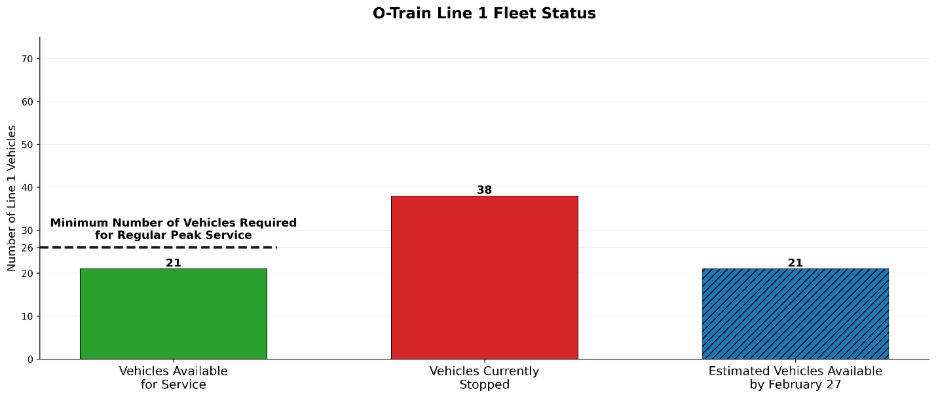
Currently, 21 vehicles are available for service, with the number available fluctuating due to other regular maintenance and inspection requirements. OC Transpo expects to maintain the increased frequency of trains during peak periods.
OC Transpo continues to work through all three streams in the action plan to safely restore capacity on Line 1.
As part of work stream 1, technical meetings with Rideau Transit Group (RTG) are continuing. Further information provided through these meetings is being analyzed by OC Transpo and independent experts. Further information is still needed to verify and validate the appropriateness of short and medium-term plans proposed by RTG, and further work is being done to better understand the supply chain status for replacement cartridge bearing assemblies (CBAs).
As part of work stream 2, RTG is conducting further technical analysis and laboratory testing of CBAs to gather additional technical details. RTG has also engaged a consultant to provide increased expertise on bearings and monitoring techniques. Further investigations of enhanced containment measures are underway.
As part of work stream 3, it remains the City’s expectation that a root cause analysis leads to a long-term solution that provides safe, stable service.
Line 2 and Line 4 are operating as planned and are not impacted by this issue.
Bus Service Delivery
The week of February 8 to February 14 saw a decline in bus service reliability compared to the preceding week. The main factor contributing to undelivered trips for the week was operator availability.
The results for February 8 to February 14 show that:
- Bus service delivery was on average 95.3%.
- Excluding days with severe winter weather, bus service delivery was 95.8%.
- 5% of scheduled trips were not delivered.
- On average, 495 buses were available every weekday, with an average weekday requirement of 500.
- 4 new electric buses completed all of their inspections and are now available for service; this helps increase the number of available buses. OC Transpo continues to expect 110 electric buses to be delivered and 89 to be available for service by the end of Q1.
As a reminder, current fleet requirements reflect a temporary decrease of 255 trips each day, resulting in a decrease of 20 buses required for service. As fleet availability improves, these trips will be added back into the schedule.
OC Transpo’s recruitment campaign is in full swing. The recruitment team is seeing strong interest from prospective bus operators and there are currently 46 candidates in training. Since the start of 2026, 15 new operators have graduated. More training courses are planned this year, with a target of 374 new trainees. This will help to stabilize operator resources.
Additional KPIs are attached to this email and published on octranspo.com.
We thank customers for their patience as we work to address service delivery challenges, and we remain committed to providing frequent, transparent updates on progress. The next update on Line 1 operations and bus key performance indicators will be shared on February 27 via email and on octranspo.com.
Feb. 13, 2026
Mayor and Members of Council,
This email is to provide an update on O-Train Line 1 service as well as the weekly update on the key performance metrics used to measure progress on our bus service delivery action plan. The information below was also shared at the Transit Committee meeting on February 12, 2026.
O-Train Line 1 Operations
O-Train Line 1 service continues to operate at three- to four-minute frequency during peak periods. Large volumes of customers are still being observed on trains, however, there has been a decrease in the amount of crowding at stations. Staff continue to be at stations during the busiest periods to support customers and respond quickly should an issue arise.
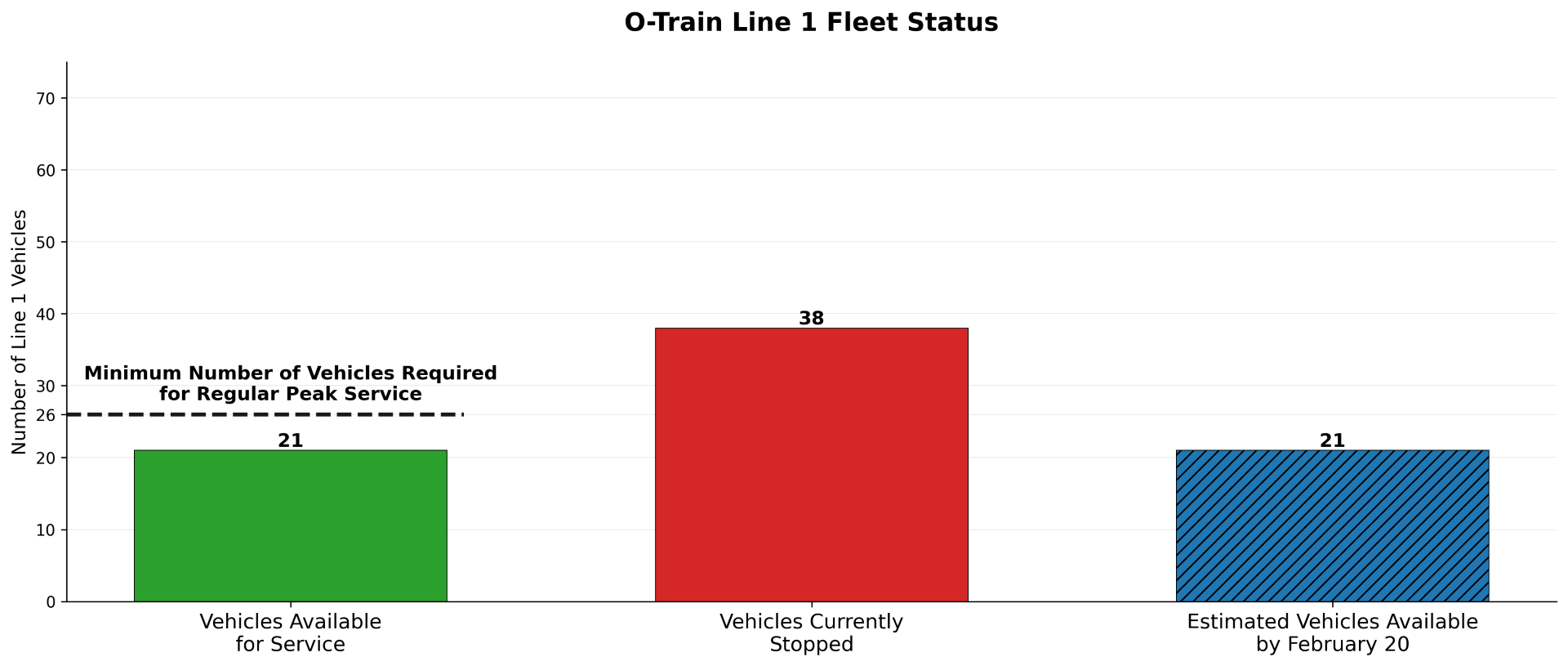
Line 1 operations will remain at an increased frequency of three- to four-minutes during peak service. OC Transpo expects 21 vehicles will continue to be available for service, with the number of in-service vehicles fluctuating due to other regular maintenance and inspection requirements.
We continue to work through all aspects of our action plan to safely restore capacity on Line 1 for customers. Technical meetings continue with Rideau Transit Group (RTG), Alstom, their external experts and the OC Transpo team. This work is complex and discussions continue. Further technical information is still required from RTG to validate and verify the containment measures and risk analysis.
We understand that this does not meet the service levels that customers expect, and we will continue to provide weekly updates on the work to safely restore capacity on Line 1.
Bus Service Delivery
The week of February 1 to February 7 saw improvements in service delivery compared to the preceding week. There was a decrease in undelivered trips, and bus availability recovered after impacts from winter weather.
Average weekday bus availability slightly exceeded the temporary daily requirement of 500 buses, for the first time since we began providing weekly updates on the bus service delivery action plan in early January. While trends over the past several weeks show progress in some key areas like fleet availability, we continue to monitor key performance indicators and make adjustments to address service delivery challenges and translate short-term progress into stability over the long term.
The results for February 1 to February 7 show that:
- Bus service delivery was on average 96.6%.
- 4% of scheduled trips were not delivered.
- On average, 503 buses were available every weekday, with an average weekday requirement of 500.
- One new electric bus has entered service and there are now 49 electric buses available.
As a reminder, current fleet requirements reflect a temporary decrease of 255 trips each day, resulting in a decrease of 20 buses required for service. As fleet availability improves, these trips will be added back into the schedule.
Additional key performance metrics are attached to this email and published on octranspo.com.
We thank customers for their patience as we work to address service delivery challenges, and we remain committed to providing frequent, transparent updates on progress. The next update on Line 1 operations and bus key performance indicators will be shared on February 20 via email and on octranspo.com.
Jan. 30, 2026
Mayor and Members of Council,
This email is to provide an update on O-Train Line 1 service as well as the weekly update on the key performance metrics used to measure progress on our bus service delivery action plan.
O-Train Line 1 Operations
O-Train Line 1 service continues to operate at three- to four-minute frequency during peak periods. Large customer crowds were reported earlier this week at some stations, and OC Transpo staff are now at key locations during the busiest periods. This has led to better crowd management and increased safety for customers. New onboard announcements have also been implemented on trains for the ongoing safety of customers including, reminding customers to stand away from the doors, make use of the capacity of the entire vehicle and to be mindful when boarding and exiting trains.
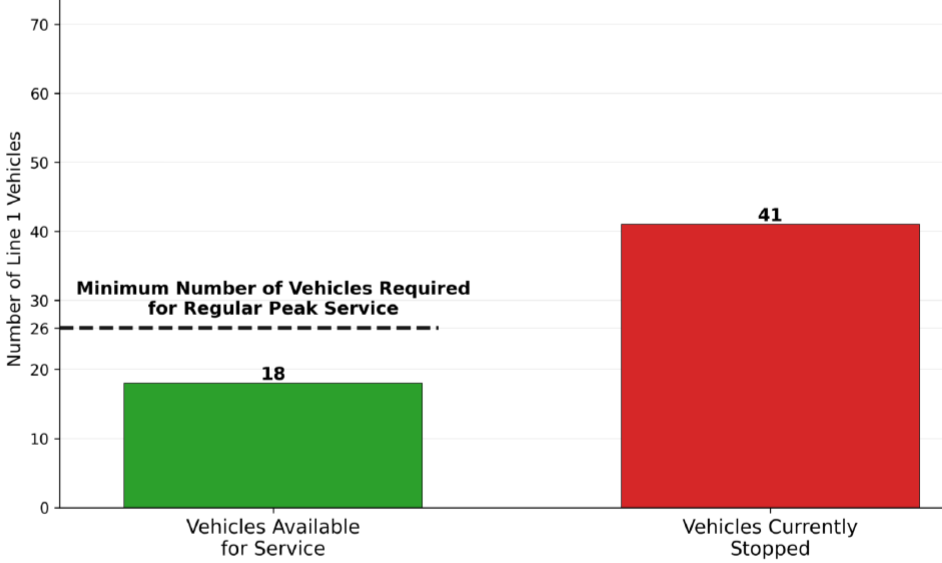
Next week, customers can expect Line 1 operations to remain at three- to four-minute frequency during peak service. OC Transpo anticipates 18 trains will be available as RTG continues to develop a CBA replacement strategy that balances increasing fleet availability with ongoing maintenance and inspection requirements. We continue to work through all streams of our action plan to restore Line 1 capacity for customers, and additional meetings began this week with RTG and Alstom’s external experts and the OC Transpo team. These discussions will continue over the coming days.
Bus Service Delivery
The week of January 18 to January 24 saw an overall improvement in bus service delivery. The number of buses available for service remained stable and there was an overall decrease in the number of undelivered trips. Current metrics reflect a temporary decrease of 255 trips each day, resulting in a decrease of 20 buses required for service. As fleet availability improves, these trips will be added back into the schedule.
While metrics are generally trending in a positive direction, we remain focused on the work required to meet our targets for bus availability and service delivery.
The results for January 18 to January 24 show that:
- Bus service delivery was on average 96.8%.
- Excluding days with severe winter weather, bus service delivery was 97.0%.
- 3% of scheduled trips were not delivered. This is a decrease from the early January peak of 6% not delivered.
- On average, 494 buses were available every weekday, with an average weekday requirement of 500.
Additional KPIs are attached to this email and published on octranspo.com.
We thank customers for their patience, and we continue to focus on stabilizing service. The next update on the Line 1 operations and bus key performance indicators will be shared on February 6 via email and on octranspo.com.