Bus Service Delivery Action Plan
Weekly Updates
Apr. 2: Bus Service Reliability Update
Mayor and Members of Council,
This email is to provide an update on O-Train Line 1 service, as well as the weekly update on the key performance metrics used to measure progress on our bus service delivery action plan.
O-Train Line 1 Operations
Over the week of March 22, O-Train Line 1 continued to operate every three to four minutes during peak periods. 22 vehicles are currently below the 100,000 kilometre limit on the Cartridge Bearing Assemblies (CBAs).
As shared in earlier updates, OC Transpo is working closely with Rideau Transit Group (RTG) to finalize details of a revised containment plan to safely increase vehicle availability. An update on the plan will be provided at the next Transit Committee.
OC Transpo’s priority continues to be the safe restoration of Line 1 capacity to normal levels.
Bus Service Delivery
With an average of 542 buses available for weekday service, this is the first time that fleet availability has significantly exceeded the temporary weekday requirement of 500 buses this year.
This increase is encouraging and can be attributed to faster onboarding of new zero emission buses into our fleet and the ongoing focus on advancing the maintenance action plan. While these results show positive progress, we are taking a long-term approach and evaluating maintenance operations to ensure fleet availability is sustained throughout the rest of the year.
The results for March 22 to 28 show that:
- Average weekly undelivered bus service was 1.5%.
- There were 715 undelivered trips this week.
- On average, 542 buses were available every weekday, with an average temporary weekday requirement of 500.
- Seven new zero-emission buses have been onboarded and are ready for service, bringing the electric bus fleet total to 85, with 109 having been delivered in the first quarter of 2026.
As a reminder, current fleet requirements reflect a temporary decrease of 255 trips each day, resulting in a decrease of 20 buses required for service. As fleet availability improves and stabilizes, these trips will be added back into the schedule.
Additional key performance metrics are attached to this email and published on octranspo.com.
We thank customers for their patience as we work to address service delivery challenges, and we remain committed to providing frequent, transparent updates on progress. The next update on Line 1 operations and bus key performance indicators will be shared on April 10 via email and on octranspo.com.
Mar. 27: Bus Service Reliability Update
Mayor and Members of Council,
This email is to provide an update on O-Train Line 1 service, as well as the weekly update on the key performance metrics used to measure progress on our bus service delivery action plan.
O-Train Line 1 Operations
O-Train Line 1 continued to operate every three to four minutes during peak periods, and 21 vehicles continued to be below the 100,000 kilometres limit on the Cartridge Bearing Assemblies (CBAs). The number of vehicles in service has fluctuated this week, and at times customers may have experienced longer wait times and some crowding on trains as a result.
As shared in earlier updates, OC Transpo continues working closely with Rideau Transit Group (RTG) to finalize details of a revised containment plan to safely increase vehicle availability These conversations have been productive and once finalized, OC Transpo will present details of the containment plan at a technical briefing.
OC Transpo’s priority continues to be the safe restoration of Line 1 capacity to normal levels.
Bus Service Delivery
Bus service for the week of March 15 reflected steady progress, with the average weekday bus availability exceeding the temporary daily requirement, resulting in very few trip cancellations due to bus availability. The total number of undelivered trips was considerably lower than in recent weeks.
The results for March 15 to 21 show that:
- Average weekly undelivered bus service was 1.6%.
- Excluding days with severe winter weather, the average weekly undelivered bus service was 0.6%.
- There were 804 undelivered trips this week.
- On average, 514 buses were available every weekday, with an average temporary weekday requirement of 500.
- Six additional zero-emission buses have been on-boarded and are ready for service, bringing the total number of electric buses in the fleet to 78.
As a reminder, current fleet requirements reflect a temporary decrease of 255 trips each day, resulting in a decrease of 20 buses required for service. As fleet availability improves, these trips will be added back into the schedule.
Additional key performance metrics are attached to this email and published on octranspo.com.
We thank customers for their patience as we work to address service delivery challenges, and we remain committed to providing frequent, transparent updates on progress. The next update on Line 1 operations and bus key performance indicators will be shared on April 3 via email and on octranspo.com
Mar. 20: Bus Service Reliability Update
Mayor and Members of Council,
This email is to provide an update on O-Train Line 1 service, as well as the weekly update on the key performance metrics used to measure progress on our bus service delivery action plan.
O-Train Line 1 Operations
O-Train Line 1 service resumed at all stations on Sunday, following last week’s freezing rain event, with service returning to operating every three- to four-minutes during peak periods on Monday. 21 vehicles remain below the 100,000 kilometre mileage limit on the Cartridge Bearing Assemblies (CBAs).
Work continues with Rideau Transit Group (RTG) to finalize the technical details of a revised containment plan for the CBAs. Once implemented, this multi-layered strategy will allow capacity on Line 1 to be safely restored. OC Transpo will present details of the containment plan at a technical briefing as soon as it is finalized.
Our first priority remains the safe restoration of Line 1 capacity. Once this is accomplished, work will continue to increase the train fleet to a sufficient number to proceed with the Trial Running phase of the O-Train East Extension. A technical briefing will be held prior to the start of Trial Running to provide more information.
Bus Service Delivery
The results for the second week of March were impacted by the freezing rain event that required adjustments to Line 1 service and the implementation of R1 bus service. With Line 1 service at all stations, bus service has recovered, and incremental progress in strengthening bus service delivery continues.
The results for March 8 to 14 show that:
- Average weekly undelivered bus service was 4.4 %.
- Excluding days with severe winter weather the average weekly undelivered bus service was 1.4 %.
- There were 1,948 undelivered trips for this week.
- On average, 501 buses were available every weekday, with an average temporary weekday requirement of 500.
- Eight additional zero-emission buses have been on- boarded and are ready for service, bringing the total number of electric buses in the fleet to 72.
As a reminder, current fleet requirements reflect a temporary decrease of 255 trips each day, resulting in a decrease of 20 buses required for service. As fleet availability improves, these trips will be added back into the schedule.
Additional key performance metrics are attached to this email and published on octranspo.com.
We thank customers for their patience as we work to address service delivery challenges, and we remain committed to providing frequent, transparent updates on progress. The next update on Line 1 operations and bus key performance indicators will be shared on March 27 via email and on octranspo.com.
Mar. 13: Bus Service Reliability Update
Mayor and Members of Council,
This email is to provide an update on O-Train Line 1 service, as well as the weekly update on the key performance metrics used to measure progress on our bus service delivery action plan. The information below was also shared at the Transit Committee Meeting on March 12, 2026.
O-Train Line 1 Operations
As shared in earlier updates, work continues to restore O-Train Line 1 service east of uOttawa Station following the issues caused by this week’s freezing rain event. Up-to-date information on service impacts is provided to customers through OC Transpo’s regular communication channels, and Council will continue to receive regular updates
With regards to Line 1 service during the week of March 1 to 7, Line 1 continued to operate every three to four minutes during peak periods, and 21 vehicles continue to be below the 100,000 kilometre mileage limit on the Cartridge Bearing Assemblies (CBAs).
OC Transpo continues working closely with Rideau Transit Group to finalize details of a revised containment plan. This plan consists of a multi-layered strategy to restore capacity while ensuring the ongoing safety of Line 1 operations. Once finalized, OC Transpo will present details of the containment plan at a technical briefing.
Our first priority remains the safe restoration of Line 1 capacity to normal levels. Once this is accomplished, work will turn to building up a sufficient train fleet to proceed with the Trial Running phase of the O-Train East Extension. A technical briefing will be held prior to the start of Trial Running to provide more information.
Bus Service Delivery
The first week of March marked the highest weekly service delivery average so far this year, representing further incremental progress toward OC Transpo’s service delivery target.
The results for March 1 to 7 show that:
- Bus service delivery was on average 97.8%.
- 2% of scheduled trips were not delivered.
- On average, 494 buses were available every weekday, with an average temporary weekday requirement of 500.
- Eight additional zero-emission buses have entered service, bringing the total number of electric buses in the fleet to 64.
As a reminder, current fleet requirements reflect a temporary decrease of 255 trips each day, resulting in a decrease of 20 buses required for service. As fleet availability improves, these trips will be added back into the schedule.
Additional key performance metrics are attached to this email and published on octranspo.com.
We thank customers for their patience as we work to address service delivery challenges, and we remain committed to providing frequent, transparent updates on progress. The next update on Line 1 operations and bus key performance indicators will be shared on March 20 via email and on octranspo.com
Mar. 6: Bus Service Reliability Update
Mayor and Members of Council,
This email is to provide an update on O-Train Line 1 service as well as the weekly update on the key performance metrics used to measure progress on our bus service delivery action plan.
O-Train Line 1 Operations
This week, O-Train Line 1 service continues to operate at three- to four-minute frequency during peak periods.
21 vehicles continue to be available for service. The exact number of trains in service at any given time can fluctuate, as vehicles may be temporarily removed for routine maintenance or unplanned issues requiring corrective work.
OC Transpo is making positive progress with Rideau Transit Group on the action plan to safely restore capacity on Line 1. Detailed technical work and safety reviews are progressing on a containment and monitoring system. As this work is finalized, updates and timelines for service recovery will be shared with Council.
Next week, customers can expect that service will continue at the current frequency during peak service.
Bus Service Delivery
The week of February 22 to 28 showed continued incremental progress on strengthening bus service delivery. Overall, the average bus availability of 509 exceeded the temporary requirement of 500 with continued improvement in bus service delivery.
The results for February 22 to 28 show that:
- Bus service delivery was on average 97.2%.
- Excluding days with severe weather, bus service delivery was 97.3%.
- 3% of scheduled trips were not delivered.
- On average, 509 buses were available every weekday, with an average temporary weekday requirement of 500.
- An additional zero-emission bus has entered service, bringing the total number of electric buses in the fleet to 56
As a reminder, current fleet requirements reflect a temporary decrease of 255 trips each day, resulting in a decrease of 20 buses required for service. As fleet availability improves, these trips will be added back into the schedule.
Additional key performance metrics are attached to this email and published on octranspo.com.
We thank customers for their patience as we work to address service delivery challenges, and we remain committed to providing frequent, transparent updates on progress. The next update on Line 1 operations and bus key performance indicators will be provided to Transit Committee on Thursday, March 12 and subsequently shared via email and on octranspo.com.
Feb. 27: Bus Service Reliability Update
Mayor and Members of Council,
This email is to provide an update on O-Train Line 1 service as well as the weekly update on the key performance metrics used to measure progress on our bus service delivery action plan.
O-Train Line 1 Operation
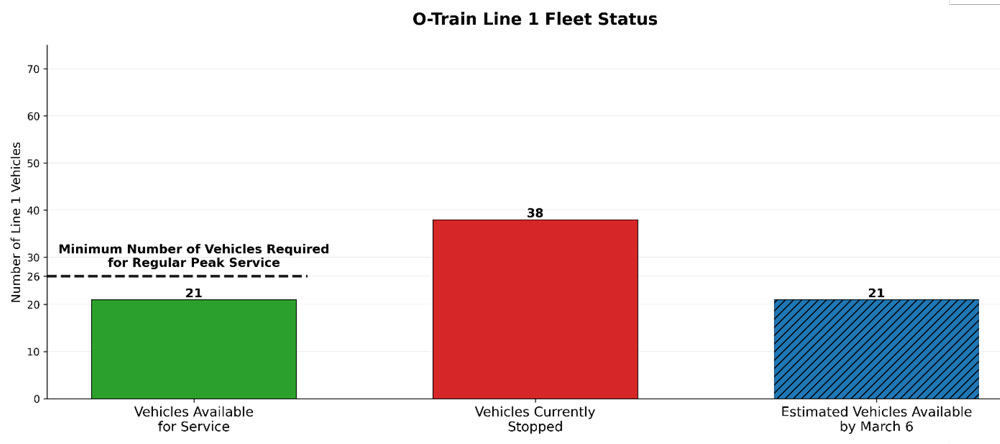
O-Train Line 1 service continues to operate at three- to four-minute frequency during peak periods. Staff are at stations during peak travel times to assist customers and respond as needed.
21 vehicles continue to have mileage below 100,000 kilometres as per the requirements of the safety order. Due to other ongoing maintenance requirements, the number of trains available for revenue service will continue to fluctuate. OC Transpo expects to maintain the increased frequency of trains during peak periods.
Technical meetings between OC Transpo and RTG are ongoing, with a focus on validation and verification of RTG’s proposed containment and monitoring systems. The review of technical information is also being conducted by independent experts, including Transportation Resources Associations (TRA).
Bus Service Delivery
The week of February 15 to February 21 showed incremental progress on increasing bus service reliability.
The results for February 15 to February 21 show that:
- Bus service delivery was on average 96.8%.
-
- Excluding days with severe weather, bus service delivery was 96.9%
- 3% of scheduled trips were not delivered.
- On average, 492 buses were available every weekday, with an average temporary weekday requirement of 500.
- Two new electric buses have entered service, and there are now 55 electric buses that are part of the bus fleet.
As a reminder, current fleet requirements reflect a temporary decrease of 255 trips each day, resulting in a decrease of 20 buses required for service. As fleet availability improves, these trips will be added back into the schedule.
Additional key performance metrics are attached to this email and published on octranspo.com
We thank customers for their patience as we work to address service delivery challenges, and we remain committed to providing frequent, transparent updates on progress. The next update on Line 1 operations and bus key performance indicators will be shared on March 6 via email and on octranspo.com.
Feb. 20: Bus Service Reliability Update
Mayor and Members of Council,
This email is to provide an update on O-Train Line 1 service as well as the weekly update on the key performance metrics used to measure progress on our bus service delivery action plan.
O-Train Line 1 Operations
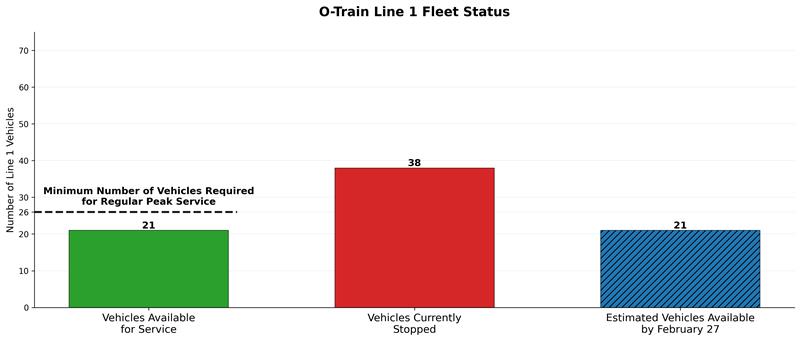
O-Train Line 1 service continues to operate at three- to four-minute frequency during peak periods. Staff are at key stations during the busiest periods to support customers. With the anticipated snowfall this afternoon, staff are prepared to respond as needed.
Currently, 21 vehicles are available for service, with the number available fluctuating due to other regular maintenance and inspection requirements. OC Transpo expects to maintain the increased frequency of trains during peak periods.
OC Transpo continues to work through all three streams in the action plan to safely restore capacity on Line 1.
As part of work stream 1, technical meetings with Rideau Transit Group (RTG) are continuing. Further information provided through these meetings is being analyzed by OC Transpo and independent experts. Further information is still needed to verify and validate the appropriateness of short and medium-term plans proposed by RTG, and further work is being done to better understand the supply chain status for replacement cartridge bearing assemblies (CBAs).
As part of work stream 2, RTG is conducting further technical analysis and laboratory testing of CBAs to gather additional technical details. RTG has also engaged a consultant to provide increased expertise on bearings and monitoring techniques. Further investigations of enhanced containment measures are underway.
As part of work stream 3, it remains the City’s expectation that a root cause analysis leads to a long-term solution that provides safe, stable service.
Line 2 and Line 4 are operating as planned and are not impacted by this issue.
Bus Service Delivery
The week of February 8 to February 14 saw a decline in bus service reliability compared to the preceding week. The main factor contributing to undelivered trips for the week was operator availability.
The results for February 8 to February 14 show that:
- Bus service delivery was on average 95.3%.
- Excluding days with severe winter weather, bus service delivery was 95.8%.
- 5% of scheduled trips were not delivered.
- On average, 495 buses were available every weekday, with an average weekday requirement of 500.
- 4 new electric buses completed all of their inspections and are now available for service; this helps increase the number of available buses. OC Transpo continues to expect 110 electric buses to be delivered and 89 to be available for service by the end of Q1
As a reminder, current fleet requirements reflect a temporary decrease of 255 trips each day, resulting in a decrease of 20 buses required for service. As fleet availability improves, these trips will be added back into the schedule.
OC Transpo’s recruitment campaign is in full swing. The recruitment team is seeing strong interest from prospective bus operators and there are currently 46 candidates in training. Since the start of 2026, 15 new operators have graduated. More training courses are planned this year, with a target of 374 new trainees. This will help to stabilize operator resources.
Additional KPIs are attached to this email and published on octranspo.com.
We thank customers for their patience as we work to address service delivery challenges, and we remain committed to providing frequent, transparent updates on progress. The next update on Line 1 operations and bus key performance indicators will be shared on February 27 via email and on octranspo.com.
Feb. 13: Bus Service Reliability Update
Mayor and Members of Council,
This email is to provide an update on O-Train Line 1 service as well as the weekly update on the key performance metrics used to measure progress on our bus service delivery action plan. The information below was also shared at the Transit Committee meeting on February 12, 2026.
O-Train Line 1 Operations
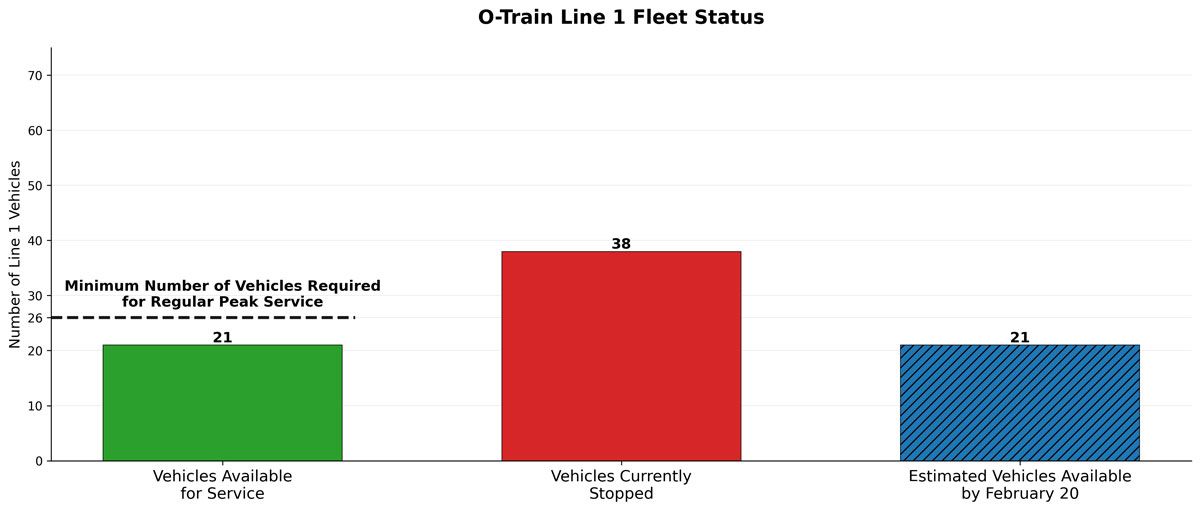
O-Train Line 1 service continues to operate at three- to four-minute frequency during peak periods. Large volumes of customers are still being observed on trains, however, there has been a decrease in the amount of crowding at stations. Staff continue to be at stations during the busiest periods to support customers and respond quickly should an issue arise.
Line 1 operations will remain at an increased frequency of three- to four-minutes during peak service. OC Transpo expects 21 vehicles will continue to be available for service, with the number of in-service vehicles fluctuating due to other regular maintenance and inspection requirements.
We continue to work through all aspects of our action plan to safely restore capacity on Line 1 for customers. Technical meetings continue with Rideau Transit Group (RTG), Alstom, their external experts and the OC Transpo team. This work is complex and discussions continue. Further technical information is still required from RTG to validate and verify the containment measures and risk analysis.
We understand that this does not meet the service levels that customers expect, and we will continue to provide weekly updates on the work to safely restore capacity on Line 1.
Bus Service Delivery
The week of February 1 to February 7 saw improvements in service delivery compared to the preceding week. There was a decrease in undelivered trips, and bus availability recovered after impacts from winter weather.
Average weekday bus availability slightly exceeded the temporary daily requirement of 500 buses, for the first time since we began providing weekly updates on the bus service delivery action plan in early January. While trends over the past several weeks show progress in some key areas like fleet availability, we continue to monitor key performance indicators and make adjustments to address service delivery challenges and translate short-term progress into stability over the long term.
The results for February 1 to February 7 show that:
- Bus service delivery was on average 96.6%.
- 4% of scheduled trips were not delivered.
- On average, 503 buses were available every weekday, with an average weekday requirement of 500.
- One new electric bus has entered service and there are now 49 electric buses available.
As a reminder, current fleet requirements reflect a temporary decrease of 255 trips each day, resulting in a decrease of 20 buses required for service. As fleet availability improves, these trips will be added back into the schedule.
Additional key performance metrics are attached to this email and published on octranspo.com.
We thank customers for their patience as we work to address service delivery challenges, and we remain committed to providing frequent, transparent updates on progress. The next update on Line 1 operations and bus key performance indicators will be shared on February 20 via email and on octranspo.com.
Feb. 6: Bus Service Reliability Update
Mayor and Members of Council,
This email is to provide an update on O-Train Line 1 service as well as the weekly update on the key performance metrics used to measure progress on our bus service delivery action plan.
O-Train Line 1 Operations
We recognize that current service on Line 1 is not meeting our standards, or the expectations of transit customers. Work is underway to safely restore capacity, while holding our maintainer accountable.
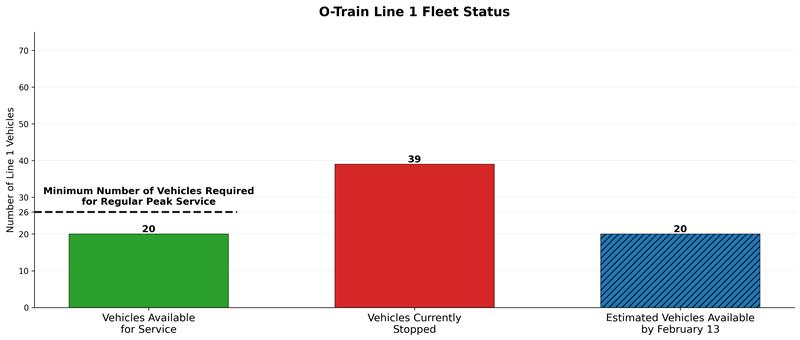
O-Train Line 1 service continues to operate at three- to four-minute frequency during peak periods. OC Transpo staff are at key locations to assist customers, with a focus on Bayview and uOttawa stations during the busiest times.
We now have 20 vehicles available for service. However, fleet availability is expected to continue to fluctuate as required maintenance is completed on the vehicles. Line 1 operations will continue at the current frequency. As fleet availability improves and can be sustained, additional trains will be returned to service and we will return to double-car trains in operation.
OC Transpo continues to make progress on the action plan to restore Line 1 capacity for customers. Technical meetings are ongoing with RTG and Alstom’s external experts. RTG continues to work through their cartridge bearing assembly (CBA) replacement strategy which balances fleet availability, ongoing maintenance and inspection requirements.
Bus Service Delivery
The week of January 25 to January 31 saw a decline in bus service reliability compared to the preceding week. The number of buses available for service decreased slightly on average due to the prevailing weather conditions.
Overall, progress is being made on the bus action plan, and improvements have been seen over the course of the month as the fleet has been able to stabilize much faster following winter weather. While we continue to monitor key performance indicators, we anticipate that the data from this week will show further stabilization and overall improvement. Further KPIs will be provided at the Transit Committee meeting on February 12.
The results for January 25 to January 31 show that:
- Bus service delivery was on average 94.4%.
- Excluding days with severe winter weather, bus service delivery was 94.7%.
- 6% of scheduled trips were not delivered.
- On average, 492 buses were available every weekday, with an average weekday requirement of 500.
- 7 new electric buses completed all of their inspections and are now available for service; this helps increase the number of available buses.
As a reminder, current fleet requirements reflect a temporary decrease of 255 trips each day, resulting in a decrease of 20 buses required for service. As fleet availability improves, these trips will be added back into the schedule.
Additional KPIs are attached to this email and published on octranspo.com.
We thank customers for their patience as we work to address service delivery challenges, and we remain committed to providing frequent, transparent updates on progress. The next update on Line 1 operations and bus key performance indicators will be shared on February 12 via email and on octranspo.com.
Jan. 30: Bus Service Reliability Update
Mayor and Members of Council,
This email is to provide an update on O-Train Line 1 service as well as the weekly update on the key performance metrics used to measure progress on our bus service delivery action plan.
O-Train Line 1 Operations
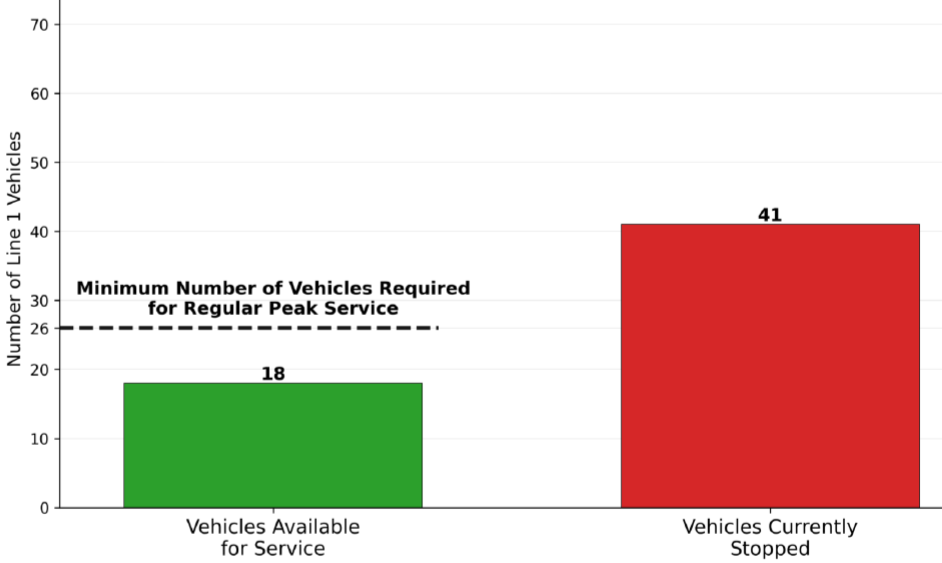
O-Train Line 1 service continues to operate at three- to four-minute frequency during peak periods. Large customer crowds were reported earlier this week at some stations, and OC Transpo staff are now at key locations during the busiest periods. This has led to better crowd management and increased safety for customers. New onboard announcements have also been implemented on trains for the ongoing safety of customers including, reminding customers to stand away from the doors, make use of the capacity of the entire vehicle and to be mindful when boarding and exiting trains.
Next week, customers can expect Line 1 operations to remain at three- to four-minute frequency during peak service. OC Transpo anticipates 18 trains will be available as RTG continues to develop a CBA replacement strategy that balances increasing fleet availability with ongoing maintenance and inspection requirements. We continue to work through all streams of our action plan to restore Line 1 capacity for customers, and additional meetings began this week with RTG and Alstom’s external experts and the OC Transpo team. These discussions will continue over the coming days.
Bus Service Delivery
The week of January 18 to January 24 saw an overall improvement in bus service delivery. The number of buses available for service remained stable and there was an overall decrease in the number of undelivered trips. Current metrics reflect a temporary decrease of 255 trips each day, resulting in a decrease of 20 buses required for service. As fleet availability improves, these trips will be added back into the schedule.
While metrics are generally trending in a positive direction, we remain focused on the work required to meet our targets for bus availability and service delivery.
The results for January 18 to January 24 show that:
- Bus service delivery was on average 96.8%.
- Excluding days with severe winter weather, bus service delivery was 97.0%.
- 3% of scheduled trips were not delivered. This is a decrease from the early January peak of 6% not delivered.
- On average, 494 buses were available every weekday, with an average weekday requirement of 500.
Additional KPIs are attached to this email and published on octranspo.com.
We thank customers for their patience, and we continue to focus on stabilizing service. The next update on the Line 1 operations and bus key performance indicators will be shared on February 6 via email and on octranspo.com.
Jan. 26: Bus Service Reliability Update
Good afternoon,
This email is to provide you with an update on O-Train Line 1 operations. Service ran as expected this morning with trains operating at an increased frequency of every three to four minutes during the morning peak period. While stations were busy, we did not observe platform crowding or vehicle overloads. Line 1 continued to operate during this morning’s weather event.
Fifteen vehicles operated during this morning’s commute and will also be in service during this afternoon’s rush hour. We anticipate that this level of train availability will continue throughout the week.
Lines 2 and 4 are not affected by this issue and operated normally during today’s snowfall.
OC Transpo will hold a technical briefing on Tuesday, January 27 at 3pm to provide further information on the Cartridge Bearing Assembly (CBA) spalling issue and work toward restoring full fleet capacity. An invitation with information on attending the briefing either virtually or in-person will be shared with Councillors this afternoon.
We continue to share updates with customers on all of our communication channels including octranspo.com, text messages, social media and public service announcements. I’d like to thank your customers for their ongoing patience during this time.
Jan. 16: Bus Service Reliability Update
Mayor and Members of Council,
The purpose of this email is to provide an update on the key performance indicators used to measure progress on initiatives that are part of the Bus Service Delivery Action Plan.
OC Transpo recognizes and appreciates that the current bus service is frustrating and disruptive for customers. Work is underway on various initiatives through the action plan to ensure buses are consistently available. We remain focused on improving bus availability in order to deliver the service our customers deserve and expect.
As mentioned in the memo from Friday, January 9, OC Transpo is committed to sharing weekly updates while bus service delivery stabilizes.
The results for January 4 to January 10 show that:
- Bus service delivery was on average 94.1%.
- 6% of scheduled trips were not delivered.
- Weekday bus availability was on average 90%. This means that on average 467 buses were available every weekday, with an average, weekday requirement of 520.
Further details on service delivery and the bus fleet can be found in this update. In addition, OC Transpo has launched a bus service delivery action plan page on octranspo.com, providing these metrics and additional information for customers.
Recognizing the ongoing challenge of bus availability, a further review and prioritization of bus schedules was completed and implemented on January 12. This means that currently 7,224 trips will be delivered each weekday. This is a temporary decrease of 255 trips, resulting in a decrease of 20 buses required for service. As fleet availability improves, these trips will be added back into the schedule.
This step was taken to respond to customer concerns about unreliable trip planning information. Moving forward, customers will see this revised and updated trip schedule in travel planning tools. We encourage customers to use the Travel Planner, Transit app, text 560560, or call 613-560-1000, for the latest information and to plan their trips.
Our team remains focused on improving bus service delivery. Our robust mechanic recruitment campaign has seen positive results in new applications over the past few weeks. We are assessing these applicants and will provide an overall update on recruitment and training at the February 12 Transit Committee meeting.
OC Transpo is also continuing to train existing mechanics to maintain Zero-Emission Buses (ZEBs). This will increase our team’s flexibility over time to maintain these new vehicles as they enter the fleet.
The next weekly update will be provided on Friday, January 23 to Council and posted on octranspo.com.
Memo to City Council
Jan. 9: Update on Current Bus Service Delivery and Action Plan
The purpose of this memo is to provide the Mayor and Members of Council with an update on the short and long-term actions OC Transpo is taking to improve bus service delivery for customers.
Recently, there has been an increase in undelivered bus trips due to an increased number of buses requiring maintenance work. This has resulted in longer wait times for customers during winter weather, unpredictable commute times, and has resulted in an increase in undelivered trips. This does not meet our service standards and we feel for our customers at this time. Addressing this and providing reliable service for customers is the top priority for everyone at OC Transpo.
Sustainable improvements to service delivery and reliability require consistent investment in transit. Through Budget 2026, Council invested $433 million to support short-term and longterm measures that will help improve service reliability for customers. This includes investments in upgrading software used to manage bus fleet maintenance, upgrading communications systems, scheduling and control systems on buses to the latest technology, funding the modification of road configurations and traffic signals at key locations. This funding builds on previous budgets that support bus procurement and lifecycle replacement of buses. These investments, in conjunction with OC Transpo’s five-year roadmap and the Transportation Master Plan, will ensure that the focus remains on improving service.
Several factors continue to affect fleet availability:
- The age of our fleet results in the need for more complex and lengthier maintenance work, meaning buses are out of service for longer periods of time; and
- Ongoing challenges to recruit required licensed mechanics resulting in a backlog of buses needing repairs.
- Supply chain issues impacting the delivery of Zero Emission Buses (ZEBs).
The challenge of fleet availability to deliver daily service is further exacerbated by traffic congestion and winter weather.
There are a number of plans and initiatives in progress to improve bus availability that will result in noticeable and consistent improvements in service delivery for customers. OC Transpo’s focus is making incremental improvements through these measures.
To mitigate the current daily reduction in bus availability, the Transit Operations Control Centre actively monitors the bus network in real time and adjusts where possible, with a focus on minimizing service gaps and improving trip consistency for customers. When there is a gap in resources, schedules are adjusted to provide customers with updated information in the Travel Planner, Transit app, and octranspo.com.
Service Delivery Action Plan
OC Transpo remains committed to improving service delivery, as we recognize service reliability is critical for our customers. OC Transpo is taking a range of short, medium, and longterm actions to address fleet issues. These include:
Short-Term Actions:
- Prioritizing critical fleet work: The maintenance team is working to triage and prioritize work, and to streamline maintenance operations to get buses back into service as quickly as possible while continuing to ensure the safety of customers and staff.
- Prioritizing critical trips: Additional schedule adjustments have been made to some routes for the winter service change in order to provide customers with more predictable bus schedules that prioritize critical trips to locations like hospitals, schools, and the first and last scheduled trips. Customers can use the OC Transpo Travel Planner, the Transit app, text 560560, or call 613-560-1000, for the latest information.
- Preventative maintenance plan: Our maintenance plan has been revised to optimize maintenance workflow, reduce preventable bus defects, ensuring that buses are returned to delivering service more quickly.
Medium-Term Actions:
- Recruitment campaign: A robust campaign to recruit mechanics and bus operators is underway. This includes a targeted ad campaign and various on-site events to increase touch points with potential employees. Recruitment of these specialized roles is an industry-wide, global challenge. The new Collective Agreement with the union representing mechanics allows OC Transpo to offer competitive wages and benefits, which will strengthen our ability to recruit and retain staff in this highly competitive labour market.
- Electric bus procurement: ZEBs to replace our aged fleet have been ordered and are being manufactured, but delivery will not be complete until late 2027. There are currently 36 electric buses in service, and we expect to receive an additional 110 electric buses by April. By the end of 2026, it is anticipated that there will be 234 new electric buses in the fleet, which will help improve bus availability. Progress on this work is provided monthly on octranspo.com. As new buses are onboarded and put into service, this will incrementally improve fleet availability and service for customers.
Long-Term Actions:
- Transit priority measures: Work is ongoing on long-term and short-term projects to reduce delays and travel time variability for buses.
- Shorter-term projects include traffic signal changes, bus-only lanes, bus stop relocation and parking adjustments on important corridors across the city.
- Long-term investments include new and expanded Transitway corridors, such as the Baseline-Heron Transitway, the Cumberland Transitway, the Kanata North Transitway, and the Heron-Walkley Transitway. Building these planned Transitway projects will remove buses from congested roads, where they experience delays from traffic.
We recognize and appreciate that this situation is frustrating and disruptive for customers, and we are working on a number of fronts to ensure buses are consistently available to deliver the service customers deserve and expect. In order to continue to provide Councillors with the latest information on the status of the fleet and service delivery, we will be providing weekly updates to Council on the incremental improvements made through our key initiatives.
If you have any questions, please contact Rami El Feghali at [Personal information redacted] or me at [Personal information redacted].
Original signed by
Troy Charter
cc:Senior Leadership Team
Transit Services Departmental Leadership Team
Director, Public Information and Media Relations
Undelivered Bus Service
The target is no more than 0.5 per cent of service not delivered. This is a measure of the weekly number of bus service hours not delivered compared to the planned weekly number of bus hours. A decrease in the weekly number of trips undelivered will show a decrease in the weekly undelivered bus service delivery.
Weekly Undelivered Trips
This is the weekly number of undelivered bus trips throughout the whole bus network. Trips that are not able to be delivered will be shown in the Travel Planner and Transit app.
Reason for Undelivered Trips
The above chart shows the top reasons a trip could not be delivered. The numbers in the column are the actual trips cancelled. The following reasons are possible:
Fleet Health
Bus fleet availability is a measure of how many buses are available to deliver service to customers. The number of buses available for service and service requirements fluctuates every day for various reasons including the number of scheduled trips changing or additional maintenance work being done.
Electric Bus Procurement
Recruitment

OC Transpo is hiring! We offer competitive salaries, medical and dental benefits, plus life insurance and long-term disability coverage. We are proud to be committed to building a diverse workforce that is representative of the people we serve every single day.
Available JobsZero-emission buses

An exciting change for OC Transpo and the City of Ottawa, as we transition from a diesel bus fleet to one that is zero-emission.
More about Zero-emission buses